
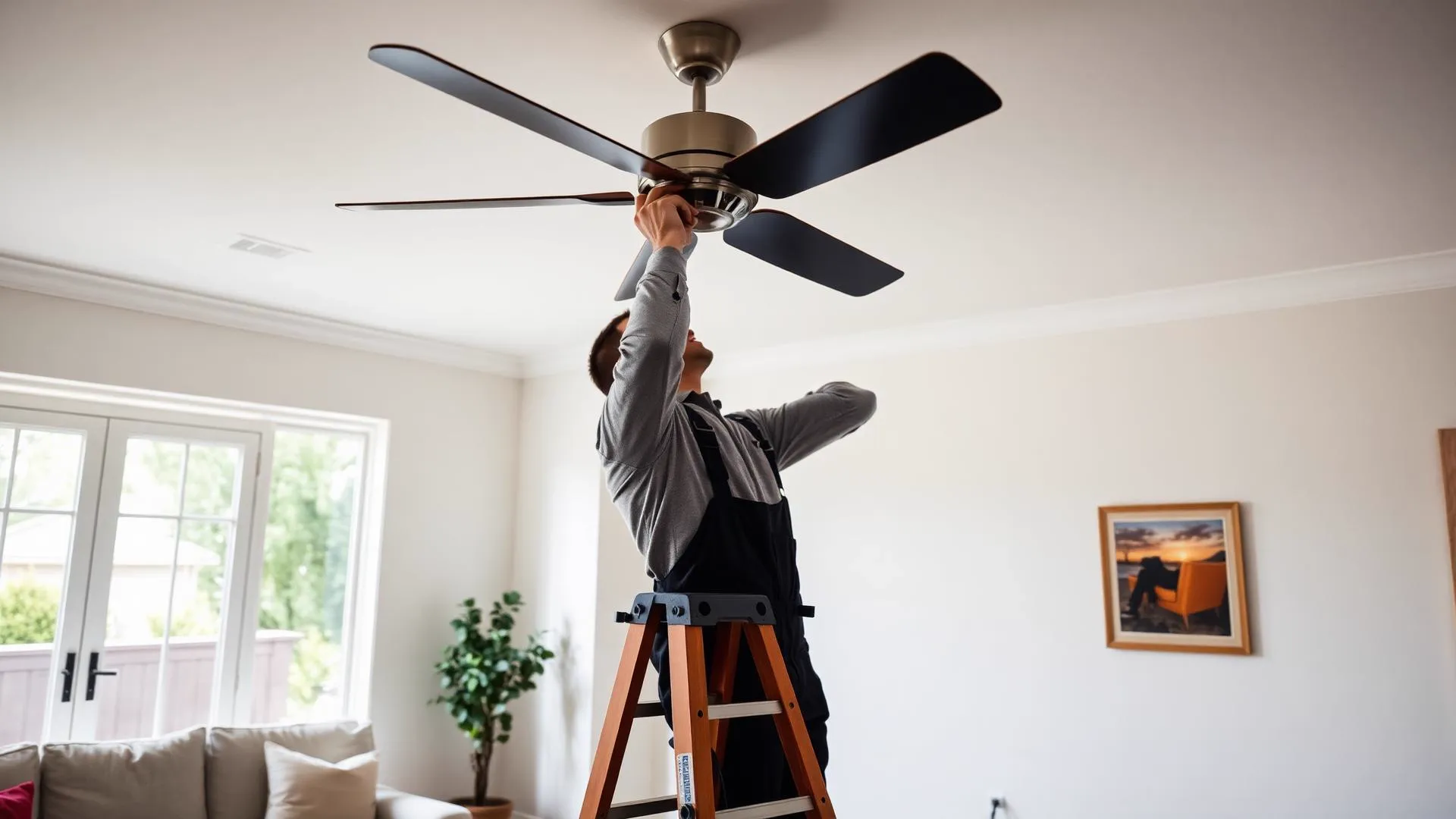
Ceiling Fan Installation in Western Chicagoland
New ceiling fan installations, direct replacements, and light-to-fan conversions by licensed Illinois electricians. Fan-rated boxes, new switch legs, wall controls or remotes, sloped and vaulted ceilings, and damp/wet-rated fans for screen porches. Illinois EC License #062-012345.
A Small Job Done Correctly
Ceiling fan installation looks straightforward from the ground — pull down the old fixture, screw on the new fan, wire nut, done. It sometimes is that simple. Often it isn't, and the difference between the two usually comes down to what's inside the ceiling: the electrical box. Every ceiling fan on the market is required by code to hang from a box specifically listed for fan support. A standard lighting box, which is what most existing ceiling locations already have, is not rated for the continuous motion and torque of a fan. Installing a fan on the wrong box is the single most common defect we find when we get called back to a DIY install where the fan is wobbling, humming, or — in a small number of cases — has partially pulled away from the ceiling.
We do fan work as a proper electrical scope. We check what's in the ceiling before we take the fixture down, we bring the right fan-rated box on the truck, and if the wiring or the switch layout needs to change to get you the control experience you actually want, we do that too. The result is a fan that hangs straight, runs quiet, and doesn't come back on us.
What We Handle
Straight Replacements
Existing fan swapped for a new one, reusing the box if it's already fan-rated. The fastest scope; often finished in an hour.
Light-Fixture-to-Fan Conversions
The existing box is almost always a standard lighting box. We replace it with a fan-rated pancake or an old-work fan brace before mounting the new fan.
New Fan Locations
No ceiling wiring today. We run a new switch leg from a nearby circuit and, on larger fans, verify the panel can support the additional continuous load.
Sloped & Vaulted Ceilings
Correct downrod length, sloped-ceiling adapter, and 8–9 ft blade-to-floor clearance calculated on the walkthrough.
Wall Controls & Remotes
Dual controls, single control plus canopy receiver, remote-only, or smart-home integration — whichever fits how you actually use the room.
Screen Porch & Covered Patio
Damp- or wet-rated fans on GFCI-protected circuits with exterior weatherproof wiring. One of our busiest summer requests.
Sizing a Fan to the Room
Undersized fans move too little air to feel; oversized fans in small rooms look and sound wrong. A workable starting point:
- Up to 144 sq ft (small bedroom, home office) — 36–42" fan
- 144–225 sq ft (standard bedroom, dining room) — 44–52" fan
- 225–400 sq ft (family room, primary suite) — 52–56" fan
- 400+ sq ft (great room, screen porch, vaulted spaces) — 60"+ fan, or two matched fans
Blade span is only half the story — motor quality and blade pitch determine actual airflow (measured in CFM). We'll flag the CFM rating of any fan you're considering and tell you whether it's going to move enough air in the room you have in mind.
Our Install Process
- 1
1. Walkthrough
We look at the ceiling, measure height and slope, inspect the existing box or the framing where a new one has to go, and confirm the switch layout.
- 2
2. Fixed-Price Quote
One number for the full scope: fan-rated box, any new wiring, wall control changes, and cleanup. Fan is either supplied by you or added to the scope of work.
- 3
3. Install Day
Power off at the panel, existing fixture and old box removed, fan-rated box installed and secured to framing, fan mounted, blades balanced, controls wired and labeled.
- 4
4. Test & Clean Up
Every speed, every direction, light kit, remote pairing. Debris packed out, drop cloths lifted, the room left the way we found it.
Why Peak Power Systems
- Illinois EC License #062-012345
- Fan-rated boxes brought on the truck — no return trip
- 25+ years of Western Chicagoland electrical work
- Fixed-price quotes, no surprise line items
- Clean drop-cloth workmanship — the room is left better than we found it
- Balanced blades and tight fit — no wobble, no rattle, no callback
Frequently Asked Questions
Can a ceiling fan hang from an existing light fixture box?
Almost never. Standard lighting boxes are rated to support the static weight of a fixture and nothing more. A ceiling fan adds continuous motion, torque, and vibration, and the code (NEC 314.27) requires any box supporting a ceiling fan to be specifically listed for that purpose — either a fan-rated pancake or an old-work fan brace box that spans between joists. When we replace a light fixture with a fan, we replace the box first. It's the single most common code violation we find on DIY fan installs.
Do I need a new circuit for a ceiling fan?
For a straight fixture-to-fan replacement in a room that already has a switched ceiling location, no — we reuse the existing wiring and swap the box. For a brand-new fan location in a room that has never had one (converting a floor-lamp-lit family room, adding a fan to a screen porch, putting one in a bedroom that only had a switched outlet), we run a new switch-leg from a nearby circuit or, depending on the load and the panel, add a small dedicated circuit. The site visit tells us which.
What are my options for controlling the fan?
Three common paths. First, a dual wall control — one switch for the fan, one for the light — using existing three-conductor romex or a run we install. Second, a single wall control paired with a canopy receiver that separates fan and light via remote or app. Third, a remote-only install where the wall switch is left as constant power and all control lives on the handheld or phone. Which one we recommend depends on how the room is currently wired and how you actually use the space.
Can you install a fan on a sloped or vaulted ceiling?
Yes. Sloped-ceiling installs require a downrod long enough to bring the blade plane below the slope and a sloped-ceiling adapter (or a fan that ships with one). Vaulted ceilings above 10 feet also need a longer downrod so the blades sit 8–9 feet off the finished floor for both airflow and clearance. We measure the ceiling angle and the finished-floor-to-peak distance before we quote so the parts are right on install day.
What size fan do I need for my room?
A workable rule of thumb: rooms up to ~144 sq ft take a 42" fan; ~144–225 sq ft take a 44"–52"; ~225–400 sq ft take a 52"–56"; and rooms larger than 400 sq ft (great rooms, primary suites, screen porches) benefit from a 60"+ fan or two smaller fans. For very long, narrow rooms, two matched fans move air better than one oversized one. We'll size it on the walkthrough and, if you already picked a fan you love, we'll tell you honestly whether it's going to move enough air in that space.
What is the seasonal direction switch actually doing?
In summer, the fan runs counter-clockwise (viewed from below), pushing air straight down for a wind-chill cooling effect on skin — you feel about 4°F cooler even though the room temperature doesn't change, which is how a fan lets you raise the AC setpoint and still stay comfortable. In winter, reversing to clockwise on a low speed pulls cool air up along the walls, gently pushing the warm air pooled at the ceiling back down without creating a draft. The switch is either on the motor housing (older fans) or in the remote/app (newer fans).
Can you install a fan on a screen porch or covered patio?
Yes, and this is one of the most-requested Western Chicagoland installs from May through September. Outdoor locations require a fan rated for the environment — 'damp-rated' for a fully covered porch, 'wet-rated' for anywhere the fan could take actual weather. GFCI protection is required on the circuit, and the mounting box needs to be code-appropriate for the location. We handle the whole scope, including any exterior weatherproof wiring.
How long does a typical install take?
A fan-for-fan replacement with an existing fan-rated box usually takes 45–75 minutes. A light-fixture-to-fan swap that requires a new fan-rated box adds 30–45 minutes. A new install that includes running new wiring to a room that has never had a ceiling fan typically takes 2–4 hours depending on attic access and switch-leg routing. We quote a fixed price per scope after seeing the ceiling and the switch location.
Related Services
Complete your backup power system with these complementary services
Doing a broader lighting refresh? Pair fans with recessed and pendant lighting and, for older homes, a quick electrical inspection to catch any circuits that need attention first. Get a quote.
Ready to Protect Your Home?
Free Generator Quote • Authorized Generac Dealer • 24/7 Emergency Service